Wednesday, June 24, 2015

Captains of Industry

   This week in class, it was up to us students to create the essential question for the unit. We divided up into groups, analyze documents, and then come up with the essential question and a total of forty multiple choice questions that will appear on our final exam. During this unit, we are learning about the monopolies in business following the Civil War. Huge businesses arose after the war and in many cases, one company would gain control of an entire industry, creating a monopoly. These monopolies are controversial because they both helped and hurt the economy and the people after the Civil War. We specifically focused on John D. Rockefeller and Andrew Carnegie who were both leaders of monopolies. Our class split into groups to cover different parts of this unit. We used sources such as several video clips from ABC Clio which we watched and took notes on. After this, we came together as a class and came up with an essential question. The essential question we came up with is, “How did the actions of monopolistic leaders, such as Rockefeller and Carnegie, affect the common worker?”

John D. Rockefeller was a very competitive man. He eventually became the leader of the oil industry. He became a wealthy man by helping the Union during the Civil War. When oil started being drilled, he saw an opportunity to prosper. He opened up a few oil companies to start pumping oil, and he started buying other competitors around him. When the depression hit, many oil companies around him started to crash, but his was able to stay efficient and strong. He saw this as an opportunity for even more power and was able to expand his company and prosper while others were crumbling. He bought out most of the oil companies in the U.S. and started partnering with intelligent business partners such as Henry Flagler. If he wasn't able to buy a company, he would partner with them so he was still able to regulate prices and gain power. He was able to keep production costs low meaning lower prices for the population. He founded the Standard Oil Company which absorbed almost all of the competing oil companies and was able to negotiate lower shipping prices, stabilizing and lowering oil prices. However, people got nervous about his ruthlessness and having too much power, and they thought he was just making decisions for greed and money. They eventually took it to the Supreme Court where he was forced to disperse his trusts. He gave a lot of his money to charities and donated to education, medicine, and science. He believed strongly in spreading his wealth, and he said in an interview with William Hoster " I believe the power to make money is a gift of God ... to be developed and used to the best of our ability for the good of mankind. Having been endowed with the gift I possess, I believe it is my duty to make money and still more money and to use the money I make for the good of my fellow man". He was able to become one of the wealthiest men in U.S. history because of his monopoly.


   Andrew Carnegie was similar to Rockefeller in that he affected the common workers positively and negatively.  To learn more about Carnegie, we read the“Andrew Carnegie Bio.”  Carnegie was once poor, but then he become one of the wealthiest men in the world, demonstrating a “rags to riches” type of story.  He became wealthy by gaining power in the U.S. steel industry.  He also used vertical integration, which was a system in which a company’s supply chain is controlled by that company.  This allowed him to control raw materials, transportation, and distribution within in the steel industry, managing every stage of the production process from beginning to end.  Similar to Rockefeller, Carnegie was also a philanthropist and he to donated millions of dollars to medicine, education, and science.  He also donated money to create libraries and promote world peace.  Carnegie also demonstrated the idea of gospel of wealth which is defined as the moral obligation to use wealth for public good.  However, although this quality of him was beneficial to the common worker, in the year of 1892 there was homestead strike of Carnegie's homestead mill.  The strike, which we learned about by watching the Homestead Strike Video, revealed Carnegie’s plan to destroy the iron and steel worker’s union, which resulted in a public outcry.  His reputation was ruined by this outcry as seen in the Editorial in the St. Louis Post Dispatch, early August, 1892.  This editorial declares the following about Carnegie, “Three months ago Andrew Carnegie was a man to be envied.  Today he is an object of mingled pity and contempt.  In the estimation of nine-tenths of the thinking people on both sides of the ocean he has not only given the lie to all his ascendants, but confessed a moral coward…”  The Homestead Strike showed how Carnegie negatively affected the common worker.  When the depression hit the United States in 1893, Carnegie used the depression to his advantage and acquired land to connect the steel producing center to the northwest water routes.  This also demonstrates how Carnegie negatively impacted the common worker.


As you can see, the Monopolistic leaders, such as Rockefeller and Carnegie, both hurt and helped the average worker. Both men monopolized their industry so it was very difficult for men already in the oil and steel business to stay afloat. Carnegie hurt his workers during the Homestead Strike, and both he and Rockefeller were later criticized by the public and media. At the same time their monopolies helped better the economy. Although they were said to be people only influenced by greed they continued to donate to charity and help better people's lives.


Freedom From Any Direction

  The main focus in class this week was freedom. The essential question for this topic was Who 'gave' freedom to enslaved Americans? Did freedom come from above or below? To what extent were Abraham Lincoln's actions influenced by the actions of enslaved Americans? Freedom from above in this case would mean that the freedom of the slaves would come from those on top of the social pyramid. These people would include officers, government officials and even President Lincoln himself. Freedom from below would include slaves that obtained freedom from their actions alone. In class, we looked at two pictures that could depict freedom from above or below. The pictures are shown below. 


The picture to the left showing President Lincoln would be considered freedom from above while the picture to the right would be considered freedom from below. We also looked at some documents from Lincoln himself.  In a open letter,  Lincoln says "If I could save the Union without freeing any slave, I would do it; and if I could save it by freeing all the slaves, I would do it; and if I could save it by freeing some and leaving others alone, I would also do that."  In this case, freedom would be coming from above, from the most powerful American at the time.  Although Lincoln did not blatantly say that he 100% wanted to free the slaves, he hinted at his opinion. In an 1862 letter from General Ambrose E. Burnside to Secretary of War Edwin M. Stanton, freedom seems to come from below.  Ambrose is telling Stanton about how his city is "being overrun with fugitives from surrounding towns and plantations", who are putting pressure on pro-slave advocates.  The "below" group is seen here taking control of their problems, and provoking a change for themselves. 

In society today we see many instances where freedom comes from below. We see many of these people who are seen as below to get reinforcement from those that are considered above. One example of this is Bruce Jenner and his recent coming out as transgender; he is an Olympic athlete, and a star on various Kardashian reality tv shows. Other transgender people have been fighting and protesting for equality, but now that a more popular and powerful voice has stepped out and represented the community equality is more possible. The story has had incredible coverage all over the place, and Bruce Jenner has become a voice for all transgender people, just like Lincoln became a voice for the enslaved people. 


Sunday, April 12, 2015

Searching for Battles

  This week, my class took part in a activity that taught us about the battles that were fought during the Civil War. Each person in my class was given a battle that we were responsible for making a Google doc for. Everyone's Google doc had to consist of four items; the title of the battle, the victor, the theater, and two bullet points describing the battle. The "theater" simply means where the battle took place; either the eastern theater, western theater, or naval theater (involving any body of water). Once we had all our information gathered, we created QR codes using a qr generator so everyone could access the Google docs. The QR codes were printed out and placed in various spots around the school. Our task was to get the information from each Google doc and paste it on to our Evernote page. At the bottom of each Google doc was a clue as to where the next QR code would be. Once we had all the information from the 20 battles gathered, we came together as a class and created a Padlet on the patterns we found while taking notes of the battles. My classes Padlet can be seen below. 


    The essential question of the week was, "Who was the ultimate victor in each of the theaters of war; East, West, or Naval?", and "What are some commonalities you can identify in the reason for the result of battles?" As you can see on the class Padlet, the Union dominated most of the western theater and naval theater while the eastern theater was primarily dominated by the Confederacy.For example, the Confederates were able to dominate the eastern theater because they were well supplied and more composed than the Union. Many battles were won by the Confederates in the eastern theater such as the battles of Fredericksburg and Bull Run. Overall it is shown that the Confederates were well supplied in the east while the Union had ships handy and well composed plans for the west. The Union dominated the naval theater in battles such as the battle of Fort Henry and the battle of Fort Donelson. The Union had ships ready to fight so they were able to dominate the Naval theater. In the Western theater the Union were able to win many battles such as the battle of Shiloh and the battle of Chattanooga. The Union were able to surround and outnumber the Confederates in many battles, which caused them to dominate this theater. 

  The scavenger-hunt activity was probably my favorite activity that we've done all year. It gave my classmates and I the chance to get out of the class and walk around the school rather sitting at a desk. It was also interesting to learn how to create the QR codes because of how easy and fast it was. One downside to this activity was the problems with the WiFi. Some spots in the school didn't have great WiFi so it slowed down the process when we had limited time. The Padlet was also a new experience for many people in my class. Although it was a little disorganized, it was a new way to see my whole class collaborate on an idea. Overall, this weeks activity was surely one of the best ones so far. 


Thursday, April 9, 2015

Getting Info with Infographics

  In class we looked at statistics, facts, and strategies of the North and the South during the time of the Civil War. The assignment was to create an infographic to show how the differences between the two effected each strategy and the outcome of the war. In my infographic that is shown below, I also add statistics that helped or harmed different sides of the war. 

Wednesday, April 8, 2015

The Election that Changed Everthing

   This week, my class learned about the election of 1860. Our essential question for the unit was how were the results of the Election of 1860 representative of the deep divisions over slavery? To answer this question, my class was assigned to make a video using the application Educreations. We first gathered information by watching a Crash Course video by John Green. Next we looked at a map from the class lesson notes on edline. This map showed that Lincoln, who was against slavery and felt as though it should be contained, completely won over the north of the country. The majority of the North, like Lincoln, was against slavery. States between the North and South voted differently. In some states Bell was the popular vote. He wanted to preserve the Union as it is while keeping slavery. Douglas believed that the way slavery should be spread is only if the people decided on it, and the only state he managed to convince was Missouri. Lastly, Breckenridge maintained that slavery should have no limits; he won over the majority of the South. With this information, we gathered pictures from The Civil War in Art page to create our videos. My groups video is below.


The Civil War in Art:
http://www.civilwarinart.org/exhibits/show/causes/introduction/the-election-of-1860-and-seces

Edline Information page:
http://www.edline.net/files/_CJKPB_/ee553a2c7835765f3745a49013852ec4/Election_of_1860_Lesson_Notes.pdf

Other sources found at end of video.Ele

The Elephant in the Room

  Recently, we have been learning about a topic that that goes with the famous phrase, "the elephant in the room". This phrase is a metaphor referring to an obvious truth that is being either unaddressed or ignored. The "elephant in the room" that we are referring to in this unit and in 19th century American politics was slavery. In class we learned about important events and people during this time such as The Compromise of 1850, Bleeding Kansas and the Lincoln-Douglas Debate. My class broke up into groups and gathered some information about these events. From the information we gathered we were able to create the timeline shown below.


We created these timelines using the application RTW Timeline. The first event that we documented was the Compromise of 1850. This compromise was only a temporary solution, to a problem that had no end in sight. The Gadsden Purchase that followed in 1853 worried Northern antislavery advocates because they couldn't get to this new territory as fast as the southerners could to settle it and vote it as either a free or slave state. As a result, the Kansas-Nebraska Act was passed which allowed Northerners to get to these new territories and settle them by railroad easier than the South could. They wanted to settle and get enough people there to vote them as salve states. The result, "Bleeding Kansas" The Missouri Compromise no longer is relevant considering it isn't being put into affect. The solutions still didn't do the trick.  To follow, Dred Scott thinks he should be free because he and his wife live in a free state, but court rules he is a slave and slaves aren't free or citizens. There was still so much controversy and no solution. This is shown when Charles Sumner makes a fiery anti slavery speech and is later attacked with a cane by Preston Brooks. This proves that slavery is still an ongoing unsolved issue that cause civilized men to resort to violence to show what they believe.


Tuesday, February 24, 2015

The Growth of Bad from the Growth of Good

   Recently in class, we began to talk about the start slavery in the United States. By looking at the The Spread of Cotton and Slavery Activity, my class was able to see the large increase in the amount of slaves from 1790 to 1860. Around the time of 1790, cotton was economically insignificant crop in the United States. Following the invention of the cotton gin by Eli Whitney, cotton became more profitable to grow. Because of this, the demand for cotton grew and it eventually became 57% of the nation's total export revenue. By 1860, the south grew 2.28 billion pounds of cotton which made $191.8 million dollars of revenue. Due to the high demands since 1790, there was a high demand for slave labor to pick the cotton. In 1790 when cotton was economically insignificant, there was approximately 690,000 slaves in the United States. By 1860, the number of slaves increased to roughly 3,954,000 slaves due to the large demand in cotton. The United Sates began to rely on the revenue of cotton being that it was 57% of the nations total export revenue. Slavery therefor became entrenched in the U.S. because of labor needed to keep up with the demand of cotton.

All this increase in cotton manufacturing had very negative affects on African slaves. They were captured from their native countries and were forced onto ships where they would eventually over a long and torturous journey land in the United States. Slaves were then bought and traded and would work in humane conditions. My class was able to get a look into the life of a slave by watching a docudrama titled A Prince Among Slaves. The movie told the story of  Abdul-Rahman, an African prince who was captured in war and was brought to America to be enslaved. We watched as he was stripped of his dignity by many including his master, Thomas Foster. Foster did things like refuse to sell him, beat him viciously and cut his hair which devastated and ripped away Rahman's identity. 


                                                                 Abdul Rahman
                                        http://webfuuta.net/pas/alfa_abdul_rahman.jpg

  While Abdul Rahman's original identity was exposed and he was eventually released as a slave, this is not the same story for many other slaves. Slaves were treated like animals and they were forced to live their lives and raise their families within the borders of their masters land.

 As you can tell slavery was a big part of the 19th century. Without it the growth of cotton and the American economy would not have been so successful. But, with the growth of cotton came the growth of slaves and overlooking human life. All Africans in America, free or enslaved were affected by slavery. People at this time tended to overlook the feelings of the the slaves that made up a large percent of the country. They were thought to be more as working machines rather than people. People never put themselves in the shoes of a slave to imagine being ripped from your family or have to work day till night just so you wouldn't get punished. The dignity of the African American slaves were wounded beyond repair.


Wednesday, February 11, 2015

The Fight for Women's Rights

    Ever since the start of civilization, women had been treated as people who are beneath men. Women have been seen as the weaker, less intelligent and less capable of preforming daily tasks of the two sexes. For centuries women have accepted this role and fell into the social stereotype that they were given. This all changed in the mid-19th century. Around this time a document was released called The Rights of Women: Laws and Practices. This document provided women with the social practices and laws that they should live their live by. Some of the laws and practices that are included is the law that its legal in most states to beat your wife with a horsewhip every couple of weeks to keep her from nagging. Another practice that is included is the practice that it is considered improper for women to speak in public. Women during this time were seen as propriety to their husbands. The only public job available for women was teaching but they were paid only 30-50% of what men were paid for the same job. Women's usual jobs included cooking, cleaning and caring for children.

   Being treated this way for so long finally got to women and they decided to do something about it. This created the Seneca Falls Convention in the fight for women's rights. Out of the Seneca Falls Convention came the Declaration of Sentiments and Resolutions, a document that stated resolutions to the Practices in The Rights of Women. The Declaration of Sentiments and Resolutions was a very controversial piece, it was the first time women had out-lashed against society, and the declaration got a lot of attention. Reactions to this declaration were both positive and negative. An article that reported on the declaration is The Mechanics Advocate, Female Department. The article states that the women's convention was "all wrong" and "any true-hearted female would think that its was unwomanly". From this article we can see that The Mechanics Advocate, Female Department was strongly against the Seneca Falls Convention. Although this was the case for this article, not all articles were like this. There were some articles that praised the convention like the National Reformer.  The National Reform said that "Their standard is now unfurled by their own hands. The convention of Seneca Falls has appealed to the country." 

    Even though women today do not face as harsh treatment as they did in the 19th century, they are still judged on most of the things they do. Women are judged on the way they dress, how they act and who they talk to both by men and other women. I think its important as women to stand together to fight for respect from men rather than tearing each other down. Often in society women can be labeled as something negative while doing the same thing as men. In this Pantene commercial shown below, we can see how women are labeled in the same situation that men are in. 

As we can see from the result of the Seneca Falls Convention, women's rights have changed in previous years. My hope for the future is that we can continue in this path and women would be seen more as equals and not be labeled negatively in the same situations as men.

Wednesday, January 21, 2015

Who Was Andrew Jackson?

   The essential question for our newest topic is, Is Andrew Jackson's long- standing reputations as "the people's president" deserved? To answer this question, my class broke up into three groups to cover topics that Andrew Jackson dealt with. The three topics were the Spoil System, the Indian Removal Act and the Bank War. Each group created a Google slide show and presented their findings to the class. By researching what each topic was, what Jackson did, and how it affected the people we could find out if Jackson really was "the people's president" or not. To answer the essential question, you would have to refer to each of the presentations. For the topic of Spoils Andrew Jackson was certainly not "the people’s president". When he was elected president he instated the spoils system in which he removed people from their current government jobs and instead gave them to people who have helped him get elected. This was disastrous because it took 919 people out of their jobs and replaced them with unqualified people. This did not only affect the 919 people that lost their jobs but the rest of society who had to suffer as well. Jackson's main goal was to protect the people during the Bank War but in the end it only created problems. Jackson wanted to protect the average business man by not letting rich people get too ahead in their businesses, but that only created a divided between the rich and poor. For the Indian Removal Act, Andrew Jackson was "the people's president" for Americans, but was not considerate for other people, such as the Indians. Jackson wanted to move the Indians west so that there was more land for the white people and ensured the Indians that moving west was a good idea for them because other Indian tribes have died out living near white people. The Indians however did not want to leave their native land but Jackson eventually forced them out and law and many died on the march to their new land. All of the presentations my class did helped me answer the essential question. My groups presentation was the spoil system which can be seen below.


Tuesday, January 13, 2015

The Rise of Democracy

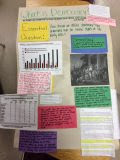
Most recently in History class we have been learning about democracy in the 1800s and how it came to be in the United States. Our goal for this lesson was to figure out the meaning of Democracy, and how active the system was in the U. S. during the 1800s. More specifically, our essential questions were how should we define and how democratic was the United States in the 1800s? To answer these questions, our groups were given seven pieces of information to analyze and attach to the posters that we would make to help answer these questions. After analyzing the information, my group came up with the definition that democracy is that democracy is a system of government where the power in vested in the people and through freely elected representatives. Also, we came to the conclusion that in the early 1800s, the US was not very democratic, but as the years progressed, it became a more and more democratic country. Below is that final product of my groups poster. 

Equality Over Everything

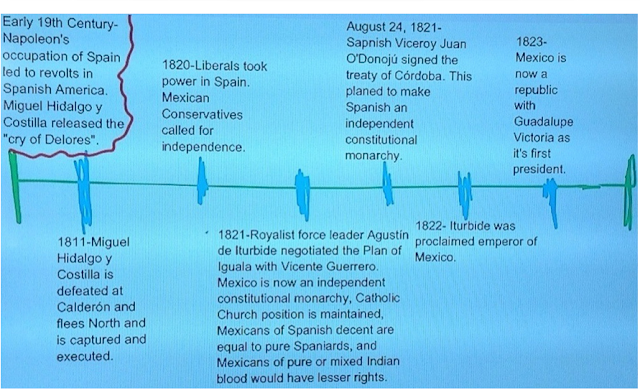
     The essential question for our unit on the Latin American Revolutions is as follows, "Why is it essential to acknowledge human value regardless of race? How are the events in the Latin American Revolutions evidence of this social imperative?". In class we studied the impact of race of the Latin American revolutions for independence. We looked at a pie chart of the percentages of certain races of that time and also the social rankings according to race. The basic idea, the more white you are the more power you have. Full whites, the Peninsulares, were on top of the social ranking but only a very small percentage of the populations. On the bottom of the social ranking, before slaves, were the Indians, who made up approximately half of the population. We then studied the effects of the Brazilian, Mexican, and Gran Colombian revolution. The class then broke into three groups. Each group was assigned one of the following counties: Brazil, Mexico, and Gran Columbia. I was in the group that was assigned Mexico. We read about our country and made a timeline of important events that took place in the country. My timeline for Mexico can be seen to the below.

     Upon sharing timelines we found some commonalities and differences. All three revolutions' primary goal was to have independence and each was successful. The differences are that the revolution of Gran Colombia resulted in several independent countries while Mexico and Brazil resulted in one. Also, the Brazilian revolution was not very violent while the other two revolutions were. Even though all three revolutions took different routes to independence each one had the issue of race inequality. In Brazil, once Pedro became King he only aloud Peninsular to become members of his cabinet. People became very unhappy and Pedro became unpopular amongst the population and later stepped down from the thrown. In Mexico the priest that launched the revolution stated three reasons to launch it, and one of those reasons was to have racial equality. Simon Bolivar united anyone who wasn't enslaved in Gran Colombia into one army to fight against the common enemy, the Spanish. Race played in all three revolutions, and in the end the banding together of other races to fight as one ended up with success. But people made judgments about different races and didn't treat them like they were important but when they all came together they victoriously fought to their common goal. 

In our world today race is still an issue, you would think that because it has caused so many problems in the past, people would realize that it should not be an issue. Recently there has been many reports of unarmed African American men who have been shot down due to a policemen suspecting they are doing something wrong; when in reality they aren’t and because of their race they have been discriminated against. This issue of race that has costed many people their lives, most definitely still needs to be considered today. People have lost their lives fighting for racial equality and if we still have not achieved that goal then what have those people died for?


Tuesday, December 16, 2014

Success or Failure?

   Following the French Revolution, many other revolutions were starting to take place. The essential question for this unit is were the revolutions of 1830 and 1848 really a failure as historians have said? We started learning about these revolutions by looking at this quote by Alexis de Tocqueville,"We are sleeping on a volcano. Do you not see that the Earth trembles anew. A wind of revolution blows, the storm is on the horizon." The class came together to analyze the quote. We said that liberals and nationalists are the sleeping volcano, the winds are the ideas of liberalism and nationalism that are spreading among the people in Europe who are unhappy, the storm on the horizon is the actual revolution that is about to come, and the Earth is trembling anew because the countries are unstable. The class then broke up into groups and we made time lines bout successes and failures. My groups timeline is below.


    The timeline starts all the way at the left with complete failure and ends at the right with complete success. In the middle is not really a success or failure and the others are partial failure and partial success. 

   Now to get started learning about the actual revolutions. we were again put into groups and each group was assigned a revolution. My group had the revolution of France in 1830.  The goals of this revolution were to extend suffrage, or establish voting rights, to win power for the middle class citizens, and to gain a constitution that would recognize the rights of the people. The opponent of this revolution was Charles X, he was the younger brother of Louis XVIII who died in 1824. “The liberty of the periodical press is suspended.…In consequence no newspaper or periodical or semi-periodical work, established or to be established, without discrimination as to the matters which shall be treated therein, shall appear, either in Paris or in the departments,”. This quote from The July Ordinances, July 25, 1830 By Charles X and His Ministers is telling the public that all rights they had to voice their opinions are now abolished. Charles X angered the people when he did this, he was attempting to keep the people in check, and to make sure that ideas of revolt couldn't spread. The outcome of this revolution was the people of France receiving a new king named Louis Philippe, who was also referred to as “The Citizen King”. “The Duke of Orleans [Louis Philippe] is a prince devoted to the cause of the Revolution…The Duke of Orleans is a citizen king, …It is from the French people that he will hold the crown.” This is an excerpt from Theirs, Adolphe.2 “Orleanist Manifesto..., and it tells that the new king was voted on. Louis Philippe extended suffrage but only for the wealthier of Frances citizens. Under his reign the upper bourgeoisie prospered, and the majority of the people were still unable to vote. The French Revolution of 1830 falls under the category of either a neutral revolution or moderately successful revolution; things were changed for the better, but not necessarily for everyone that was asking for the change.

 All in all, I think that the revolutions of 1830 and 1848 were not failures like historians have said. I think that the only one I would call a failure is the Decembrists Revolt. The others were not successes, but definitely were not complete failures. The people were able to put up a fight against their government and see changes although the changes still didn't satisfy everyone. Even if the change didn't last long, the people were still able to get what they wanted across to the government in order for them to make a change. The people of this time were able to make their voices heard.


Balancing the Peace

   The Congress of Vienna was a peace conference in 1814 that was held in Austria. France, Prussia, Austria, Russia, and Great Britain gathered to come up with a peace treaty following Napoleon's defeat. In class we started with the essential question that asked what people should do if their power is threatened. We then learned about Klemens von Metternich and his relationship with Napoleon. We watched a clip of a movie where Metternich and Napoleon had a meeting were Metternich was seeking peace with Napoleon in Dresden. Then as a class we discussed the Congress of Vienna and viewed a interactive map of the changes in Europe and the land boundaries of that time. By the end of the class, after looking at all these activities, we can up with an idea as to what people do to protect their power.
   
   When powerful people feel like their power is being threatened they will first fight to keep their power, and then create a balance of power that so no one will try to take over and threaten their own power again. As we learned from our sources in class, Metternich, who is an official from Austria, power was being threatened by Napoleons conquests. Other big powers in Europe such as Prussia and Russia, were feeling threatened as well. Surrounding countries held The Congress of Vienna to try to make peace. After a long battle Napoleon was finally exiled to Elba then Saint Helena. The Congress then decided to balance their power between themselves. This was to prevent anyone from taking over land like Napoleon had and causing chaos. Also, as seen in the interactive map, the congress divided land among the four big powers, Austria, Prussia, France, and Russia, and made new boarders for these countries. The government officials were happy with these new changes and some order was restored after the Congress of Vienna.

   In my opinion, what the attendees of the Congress of Vienna did was effective and the right choice. I think they should have not completely just make decisions and take away land from other countries like Italy because it wasn't fair, but for the most part what they did prevented revolutions for the next 40+ years. I think that the people with the most power always should make sacrifices and give up some of their power to others in order to keep any issues from arising. Napoleon had gained so much power he just fell apart and people were upset everywhere with some of what he was doing. What really makes a powerful leader, is being one that is loved by his people, so giving up sacrifices is necessary for this to happen.


Napoleon Bonaparte
http://cdn.medindia.net/health-images/nepolean.jpg                Klemons von Metternich
                                                                                  http://upload.wikimedia.org/wikipedia/commons/3/3b/Graf_Clemens_Metternich.jpg 

The Most Ideal of the Ideologies

   To begin our lesson on the ideologies of the 19th century, we were given an essential question. The essential question is as follows, "What were the major political ideologies of the 19th century and how did they influence social and political action?". To learn more about this topic, we started by looking up the terms liberalism, conservatism and nationalism. We took a few notes on these terms then our class came together to discuss them. we then discussed what the word ideology actually meant. Ideologies are ideas that are formed by someone or a group of people, that forms the basis of economic or political theory and policy. To better understand these three ideologies, my class was broken up into groups to research them. Each ideology was covered by two groups that were responsible to present a sixty second presentation. My group was assigned liberalism. For our presentation, we decided to use the chatter pix to explain our ideology. A screenshot from our final presentation is below.


                                          A screenshot from our video were John Locke was talking
  Our presentation explains the creation as well as what liberalism means. Liberalism is the idea that the middle class has a say in government and that everyone has god given natural rights that need to be protected. Liberalism prevented tyrannic rule and promoted freedom of though and natural rights. However, liberals did not want a democracy, instead they left out the women and poor but gave the middle class a say. It influenced the social and political action because the liberals had opposite ideas from the conservatives and made the middle class happy, but not the poor.  

  After we presented our presentation, we would watch other groups presentations to learn about the other ideologies. Another ideology we learned about is nationalism. Nationalism is when a nation wants to be united and the best and strongest nation it can be. They wanted to be strong and able to conquer others and drive out foreign rulers. Nationalists believed that people were bound together by sharing the same culture, language, and history. The nationalists would not focus on social classes and power as much as how they should all be united as one strong nation. The last ideology we learned about is conservatism. Conservatives believe that the traditional political and economic ways should be kept in use. They do not believe in reform and do not want a revolution. They wanted to preserve the system of aristocracy and set social structures. They liked traditional monarchies. This influenced social and political action because it was giving power to specific people like the monarch.


Wednesday, November 5, 2014

Conqueror of Countries

    Recently, my class started reviewing the life of Napoleon Bonaparte. The essential question for this lesson is, "What was Napoleon's impact on the social, economic, and political systems of Europe?" To get started on the life of Napoleon, we watched the video below,


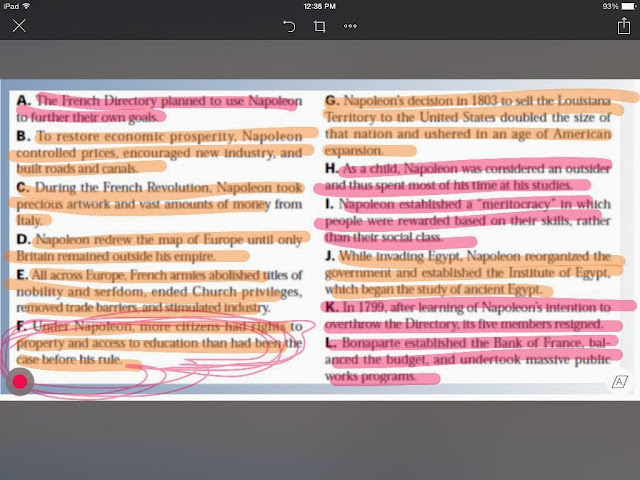
While we watched this video, we took notes on all the places Napoleon had conquered. My class came up with a long list that included places like Italy, Belgium, Holland, Spain and many more. This helped us realizes that Napoleon was a strong leader if he was able to conquer all of these places during his lifetime. We then looked at two views from different people on Napoleon. The first view was from a women named Madame de Stael. She was a member of the mobility and the daughter of King Louis XVI's former financial adviser. Madame de Stael goes on to talk about how Napoleon would persuade men to go into battle with him and when he became head of government, he had no formal plan for a universal monarchy. The main reason Madame de Stael disliked Napoleon is because he made the classes more even which was a negative to those like de Stael in the higher class. The other view is from Marshal Michel Ney. Ney was an officer that served closely to Napoleon for many years. Ney supported Napoleon by calling him things like sovereign, and says the Napoleon has the right to rule over the country of France. Lastly, we viewed the image below and highlighted Napoleon did that made an impact on the whole world and on France. The text highlighted in pink represents pink and the text highlighted in orange represents the rest of the world. 


    From these sources, we can see how Napoleon impacted the areas in the Essential Question. He impacted the political system in a positive way by his ideas of meritocracy which rewarded people based on their talents and hard work, not because of their social rank. Napoleon impacted the social system by giving more people the rights to property and access to education. Lastly, he impacted the economic system in a positive way by removing trade barriers and stimulating industry. He also was able to steal money from Italy, and created the Bank of France which involved having a budget system and massive public work systems. At first look at Napoleon Bonaparte, you might think more along the line of Madame de Stael, and think that he is a greedy tyrant that will trick and force people into war with him. But, when you see how a lot of his actions have greatly impacted France in a positive way. In the words of the former Duke of Wellington, (Napoleon's greatest nemesis), "Napoleon was the greatest general that ever lived".  


Monday, November 3, 2014

Which Way Works?

     The other day in class, we did an activity that would later connect to our newest lesson plan. We were trying to understand the ideas of Karl Marx and Adam Smith on the economy. My teacher started giving us two pieces of chocolate, with the exception on two students that got eight pieces. This represented the 90% of poor citizens during this time, while the other 10% being wealthy. My teacher then instructed us to play rock-paper-scissor. If we lost the game, we would have to give up a piece of chocolate. If we won the game, we would receive a piece. When all of your candy was gone you would have to sit down. The trade of candy and our freedom of competition represents Adam Smiths idea of the the invisible hand which found out would be Capitalism. The tournament went on until only a few students had the majority of the candy. We came together as a class after and concluded that the students that started with more candy had an advantage over everyone else. My teacher then unexpectedly collected the candy and redistributed the candy so everyone had two pieces. This was representing Karl Marx's idea of socialism and how the government would take all materials and redistribute them equally among the traders. The people who had won the candy for themselves thought this was unfair because they worked for the candy and then they had to share it. A question was then posed that if we had a chance to play rock-paper-scissors again to potentially gain or loose candy, would you do it? When we all agreed to sharing an equal amount, this represented communism and the government no longer being needed. This activities purpose was to connect us to the theories or capitalism, socialism and communism. I liked doing this activity because it made me more interested in the lesson because it was a change from just taking notes. Also, every step we took during the activity connected to something we were learning so it was easy to follow. 

   Since we now know Karl Marx's idea of socialism and the theory of communism, we can compare it to the ideas of Adam Smith. To get to know a little about Smiths ideas, we watched the video below:


This video talks about Adam Smith's idea of "the invisible hand". The idea of the "invisible hand" is that government should leave people alone to buy and sell as they please. This leaves sellers to compete with each other and the consumers would be drawn to the supplier who is selling the most for as little money; almost by a invisible hand. This theory and Capitalism are the same thing. Smith thought that Capitalism would be the best plan to help with the poor because the prices of good quality supplies would go down due to supplier competition. Karl Marx argued that this theory does not help the poor and they will later revolt. Marx thought the best way to help the poor was by creating a system themselves that would end in everyone being equal. This would eliminate class division.

    I think that the idea of Adam Smith's would be the best way to go. The idea leaves government out of the equation, so nobody would have anyone to blame but themselves. Also, prices would go down in result from suppliers having to compete with each other. Also, those who have worked the hardest would see the most benefits because they are not bound to be equal than those who have not worked so hard. I think it would help people realize that the government cant control everything and that people had to work hard for themselves.


Sunday, October 19, 2014

Working Women


            Recently, we learned about an experiment that was used during the Industrial Revolution to convince girls to work in the Lowell mills. This experiment was used because unlike Great Britain, the U.S. did not have an abundance of cheap labor. The Lowell Experiment was a way to convince young girls and their families to let the girls leave home and come work in the mills. The mill recruiters would promise families to watch over the girls and instill a mature code of behavior. The girls would get paid and send home some money that would help their families cover their debts and expenses. Mill recruiters would make going to work at the mills seem like an amazing experience. The girls benefited from going to the mills by being bale to get some spending money themselves so they could buy whatever they would want. Also, the girls time worked in the mills were temporary and they would leave as soon they were old enough to marry. The downside to working in the mills were that the girls were separated from their families and would miss part of their childhoods. The girls would also face wage cuts and get little pay for all of the long hours of work. Lastly, the mills were a very dangerous place to work. Many cases of working in mills would often lead to serious injury or even death. During this time, mill owners would feel that they could do anything they felt would improve their own status because they knew that working in the mills were the only jobs most of the girls would ever have. This reflected views of women during this time because it shows that women were not valued as workers and the mill owners could treat the women as they pleased. Eventually, the wage cuts left women to start revolting against the mill owners. These revolts left a mark on labor rights for the future years of the Lowell mills.
Above is a picture of some girls that worked in the Lowell mills during
The Lowell Experiment and the women's worker revolt.

Sunday, October 5, 2014

Google Hangout

     This week in class, we got the opportunity to chat with Jamie, an expert/explainer from the Museum of Science and Industry. To start with this activity, we watched a video of Jamie giving a tour of the museum. He showed all of the old machines that were used during the Industrial Revolution. My class then searched the web for some of the definitions to the machines Jamie was talking about. We then made questions that we could ask Jamie when it was time to video chat him.
 
      After doing some more backup information, we were ready to start our chat. Jamie started by going around to each machine and explained how they were used. Jamie said that the earliest machinery was a loom that was used in houses. When more product was in demand, people were forced to abandon the at-home looms and go to factories. We learned how cotton was turned into product starting with the hopper feeder scutcher and ending with the flyers. Jamie also talked about the living conditions while working in the mills. Children were forced to go work at the mills to pay off their families debt. While working, the workers would get ill and physical deformities from standing all day and breathing in the contaminated air. Eventually, factory owner would take orphans form the local orphanage to do the work because it was cheaper than hiring other workers. Jamie then went on to talk about his work at the museum. He wanted to work at the museum because he has always been interested in the Industrial Revolution. He walks around the museum giving tours and answering questions for visitors. My class was very fortunate to get an online tour.
   
    Overall, I thought this experience was very helpful for better understanding life during the Industrial Revolution. It was helpful to see the machines not in a picture and to have each piece be explained. One drawback to the online hangout was that the Internet would sometimes cut out which would make it hard to hear what Jamie had to say. I hope that in the future my class will be able to do another web chat from and online source because it gives us more first hand information without actually be there in person.


Sunday, September 28, 2014

A Walk in the Museum


This week in class, we were broken up into groups to create an exhibit for a museum that would help us better understand some of the aspect that went along with the Industrial Revolution. For our exhibit, my group was given the topic of child labor. To the right is the final product of my group's museum exhibit we worked on in class. Each group was given artifacts that correspond with your groups topic. My group and I began analyzing the pictures and notes that were given to us so we could write what each item is about. We then started to create the poster. We put on each artifact with their summaries and we then added other decoration that we thought would fit the topic. We chose to do a black background with chains going from each artifact because it represented the dark and depressing state these children were in while working in the factories. We added things like cotton balls and fabric to represent coal and textiles that the children worked with. My group wanted to really give off the feeling that these children were put through harsh and dangerous condition. After we were done and hung the poster, we got the check out the other groups posters.
     The first group I visited had the topic of family-used looms. Families would have their own looms in their houses that became very valuable. As new inventions were created and mills were becoming more common, the home looms were not up to working standards anymore. This caused a lot of families to move into the city and get jobs in factories.
     Another group I visited had the topic of transportation. I learned that the invention of steam engines helped increase transportation by introducing railroad systems and steam boats. Workers would use these new inventions to transport goods at a faster rate.
    The next group I visited had the topic of living conditions during the Industrial Revolution. I learned that with all the factories producing large amounts of goods, it caused major cities to become polluted. Workers who lived in the cities would become very ill and living conditions were becoming more and more expensive.
    The last group I visited had the topic of slavery during the Industrial Revolution. Slaves had a huge role in the productivity of the factories. With the increase of demand of goods, more slaves were put to work in the factories.

Thursday, September 18, 2014

Industrialized Inventions

        For my first unit in History 10, my class is learning about the Industrial Revolution. We started the unit by watching a brief video that gave us information about the Revolution. To watch the video, press here. The essential question for this post is what was 'revolutionary' about the revolution? We can categorize the things most effected in the Industrial Revolution into four groups, people, technology, resources and transportation. For this post, I am going to be talking about the two that I think are most important, people and technology.
         Before the Industrial Revolution, most people were farmers. Actually, about 80% of people were farmers who sold their crops for money or just used the goods for their own families. Today, only 1% of people are recorded farmers. This all has to do with the way the Industrial Revolution helped make farming easier and more efficient. Techniques were made to help the farmers like starting using fertilizers, making fields larger, and tools were made to harvest more with the use of less farmers. Also, goods could now be eaten do to the new techniques and fertilizers. Enclosures were also starting to be built to keep out peasant farmers to create more room for cultivation. Also, there was more room for sheep pastures which created more wool to be collected. With all the surplus amount of goods, the health of the people was increasing. Famine was no longer a problem and the birth rate increased with giving birth being safer. The Industrial Revolution made it so people could do their jobs faster and more efficiently.
         During the Industrial Revolution, new technology was being made that made doing jobs faster. Many new machines were being made especially for the clothing industry that allowed making clothes easier and with less people. Inventions like the  spinning jenny, flying shuttle and the water frame all increased productivity in the industry. These machines ushered in the new era of factories. More machines could be stored at once which caused more clothes to be made. With the factories in full swing, more electrical energy was needed. The problem was solved with the invention of the steam engine that made electrical energy by burning coal to boats, power trains and the new factories. New ways to make iron cheaper and stronger were possible thanks to the Darby family. The iron was used on railroads which helped transport goods faster. Below, are some of the machines invented during the Industrial Revolution.

                                                           The spinning jenny: Link here.                                   


 The water frame: Link here.


                                                           The flying shuttle: Link here.