Ever since the start of civilization, women had been treated as people who are beneath men. Women have been seen as the weaker, less intelligent and less capable of preforming daily tasks of the two sexes. For centuries women have accepted this role and fell into the social stereotype that they were given. This all changed in the mid-19th century. Around this time a document was released called The Rights of Women: Laws and Practices. This document provided women with the social practices and laws that they should live their live by. Some of the laws and practices that are included is the law that its legal in most states to beat your wife with a horsewhip every couple of weeks to keep her from nagging. Another practice that is included is the practice that it is considered improper for women to speak in public. Women during this time were seen as propriety to their husbands. The only public job available for women was teaching but they were paid only 30-50% of what men were paid for the same job. Women's usual jobs included cooking, cleaning and caring for children.
Being treated this way for so long finally got to women and they decided to do something about it. This created the Seneca Falls Convention in the fight for women's rights. Out of the Seneca Falls Convention came the Declaration of Sentiments and Resolutions, a document that stated resolutions to the Practices in The Rights of Women. The Declaration of Sentiments and Resolutions was a very controversial piece, it was the first time women had out-lashed against society, and the declaration got a lot of attention. Reactions to this declaration were both positive and negative. An article that reported on the declaration is The Mechanics Advocate, Female Department. The article states that the women's convention was "all wrong" and "any true-hearted female would think that its was unwomanly". From this article we can see that The Mechanics Advocate, Female Department was strongly against the Seneca Falls Convention. Although this was the case for this article, not all articles were like this. There were some articles that praised the convention like the National Reformer. The National Reform said that "Their standard is now unfurled by their own hands. The convention of Seneca Falls has appealed to the country."
Even though women today do not face as harsh treatment as they did in the 19th century, they are still judged on most of the things they do. Women are judged on the way they dress, how they act and who they talk to both by men and other women. I think its important as women to stand together to fight for respect from men rather than tearing each other down. Often in society women can be labeled as something negative while doing the same thing as men. In this Pantene commercial shown below, we can see how women are labeled in the same situation that men are in.
As we can see from the result of the Seneca Falls Convention, women's rights have changed in previous years. My hope for the future is that we can continue in this path and women would be seen more as equals and not be labeled negatively in the same situations as men.
Wednesday, February 11, 2015

Wednesday, January 21, 2015
Who Was Andrew Jackson?
The essential question for our newest topic is, Is Andrew Jackson's long- standing reputations as "the people's president" deserved? To answer this question, my class broke up into three groups to cover topics that Andrew Jackson dealt with. The three topics were the Spoil System, the Indian Removal Act and the Bank War. Each group created a Google slide show and presented their findings to the class. By researching what each topic was, what Jackson did, and how it affected the people we could find out if Jackson really was "the people's president" or not. To answer the essential question, you would have to refer to each of the presentations. For the topic of Spoils Andrew Jackson was certainly not "the people’s president". When he was elected president he instated the spoils system in which he removed people from their current government jobs and instead gave them to people who have helped him get elected. This was disastrous because it took 919 people out of their jobs and replaced them with unqualified people. This did not only affect the 919 people that lost their jobs but the rest of society who had to suffer as well. Jackson's main goal was to protect the people during the Bank War but in the end it only created problems. Jackson wanted to protect the average business man by not letting rich people get too ahead in their businesses, but that only created a divided between the rich and poor. For the Indian Removal Act, Andrew Jackson was "the people's president" for Americans, but was not considerate for other people, such as the Indians. Jackson wanted to move the Indians west so that there was more land for the white people and ensured the Indians that moving west was a good idea for them because other Indian tribes have died out living near white people. The Indians however did not want to leave their native land but Jackson eventually forced them out and law and many died on the march to their new land. All of the presentations my class did helped me answer the essential question. My groups presentation was the spoil system which can be seen below.
Tuesday, January 13, 2015
The Rise of Democracy
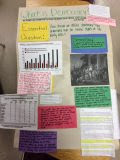
Most recently in History class we have been learning about democracy in the 1800s and how it came to be in the United States. Our goal for this lesson was to figure out the meaning of Democracy, and how active the system was in the U. S. during the 1800s. More specifically, our essential questions were how should we define and how democratic was the United States in the 1800s? To answer these questions, our groups were given seven pieces of information to analyze and attach to the posters that we would make to help answer these questions. After analyzing the information, my group came up with the definition that democracy is that democracy is a system of government where the power in vested in the people and through freely elected representatives. Also, we came to the conclusion that in the early 1800s, the US was not very democratic, but as the years progressed, it became a more and more democratic country. Below is that final product of my groups poster.
Equality Over Everything
 The essential question for our unit on the Latin American Revolutions is as follows, "Why is it essential to acknowledge human value regardless of race? How are the events in the Latin American Revolutions evidence of this social imperative?". In class we studied the impact of race of the Latin American revolutions for independence. We looked at a pie chart of the percentages of certain races of that time and also the social rankings according to race. The basic idea, the more white you are the more power you have. Full whites, the Peninsulares, were on top of the social ranking but only a very small percentage of the populations. On the bottom of the social ranking, before slaves, were the Indians, who made up approximately half of the population. We then studied the effects of the Brazilian, Mexican, and Gran Colombian revolution. The class then broke into three groups. Each group was assigned one of the following counties: Brazil, Mexico, and Gran Columbia. I was in the group that was assigned Mexico. We read about our country and made a timeline of important events that took place in the country. My timeline for Mexico can be seen to the below.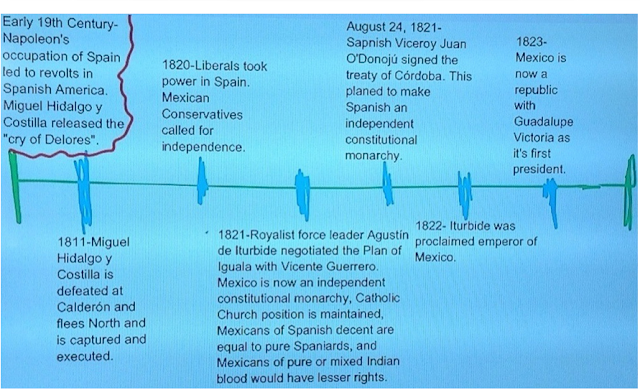
Upon sharing timelines we found some commonalities and differences. All three revolutions' primary goal was to have independence and each was successful. The differences are that the revolution of Gran Colombia resulted in several independent countries while Mexico and Brazil resulted in one. Also, the Brazilian revolution was not very violent while the other two revolutions were. Even though all three revolutions took different routes to independence each one had the issue of race inequality. In Brazil, once Pedro became King he only aloud Peninsular to become members of his cabinet. People became very unhappy and Pedro became unpopular amongst the population and later stepped down from the thrown. In Mexico the priest that launched the revolution stated three reasons to launch it, and one of those reasons was to have racial equality. Simon Bolivar united anyone who wasn't enslaved in Gran Colombia into one army to fight against the common enemy, the Spanish. Race played in all three revolutions, and in the end the banding together of other races to fight as one ended up with success. But people made judgments about different races and didn't treat them like they were important but when they all came together they victoriously fought to their common goal.
In our world today race is still an issue, you would think that because it has caused so many problems in the past, people would realize that it should not be an issue. Recently there has been many reports of unarmed African American men who have been shot down due to a policemen suspecting they are doing something wrong; when in reality they aren’t and because of their race they have been discriminated against. This issue of race that has costed many people their lives, most definitely still needs to be considered today. People have lost their lives fighting for racial equality and if we still have not achieved that goal then what have those people died for?
Tuesday, December 16, 2014
Success or Failure?
Following the French Revolution, many other revolutions were starting to take place. The essential question for this unit is were the revolutions of 1830 and 1848 really a failure as historians have said? We started learning about these revolutions by looking at this quote by Alexis de Tocqueville,"We are sleeping on a volcano. Do you not see that the Earth trembles anew. A wind of revolution blows, the storm is on the horizon." The class came together to analyze the quote. We said that liberals and nationalists are the sleeping volcano, the winds are the ideas of liberalism and nationalism that are spreading among the people in Europe who are unhappy, the storm on the horizon is the actual revolution that is about to come, and the Earth is trembling anew because the countries are unstable. The class then broke up into groups and we made time lines bout successes and failures. My groups timeline is below.


The timeline starts all the way at the left with complete failure and ends at the right with complete success. In the middle is not really a success or failure and the others are partial failure and partial success.
Now to get started learning about the actual revolutions. we were again put into groups and each group was assigned a revolution. My group had the revolution of France in 1830. The goals of this revolution were to extend suffrage, or establish voting rights, to win power for the middle class citizens, and to gain a constitution that would recognize the rights of the people. The opponent of this revolution was Charles X, he was the younger brother of Louis XVIII who died in 1824. “The liberty of the periodical press is suspended.…In consequence no newspaper or periodical or semi-periodical work, established or to be established, without discrimination as to the matters which shall be treated therein, shall appear, either in Paris or in the departments,”. This quote from The July Ordinances, July 25, 1830 By Charles X and His Ministers is telling the public that all rights they had to voice their opinions are now abolished. Charles X angered the people when he did this, he was attempting to keep the people in check, and to make sure that ideas of revolt couldn't spread. The outcome of this revolution was the people of France receiving a new king named Louis Philippe, who was also referred to as “The Citizen King”. “The Duke of Orleans [Louis Philippe] is a prince devoted to the cause of the Revolution…The Duke of Orleans is a citizen king, …It is from the French people that he will hold the crown.” This is an excerpt from Theirs, Adolphe.2 “Orleanist Manifesto..., and it tells that the new king was voted on. Louis Philippe extended suffrage but only for the wealthier of Frances citizens. Under his reign the upper bourgeoisie prospered, and the majority of the people were still unable to vote. The French Revolution of 1830 falls under the category of either a neutral revolution or moderately successful revolution; things were changed for the better, but not necessarily for everyone that was asking for the change.
All in all, I think that the revolutions of 1830 and 1848 were not failures like historians have said. I think that the only one I would call a failure is the Decembrists Revolt. The others were not successes, but definitely were not complete failures. The people were able to put up a fight against their government and see changes although the changes still didn't satisfy everyone. Even if the change didn't last long, the people were still able to get what they wanted across to the government in order for them to make a change. The people of this time were able to make their voices heard.
Balancing the Peace
The Congress of Vienna was a peace conference in 1814 that was held in Austria. France, Prussia, Austria, Russia, and Great Britain gathered to come up with a peace treaty following Napoleon's defeat. In class we started with the essential question that asked what people should do if their power is threatened. We then learned about Klemens von Metternich and his relationship with Napoleon. We watched a clip of a movie where Metternich and Napoleon had a meeting were Metternich was seeking peace with Napoleon in Dresden. Then as a class we discussed the Congress of Vienna and viewed a interactive map of the changes in Europe and the land boundaries of that time. By the end of the class, after looking at all these activities, we can up with an idea as to what people do to protect their power.
When powerful people feel like their power is being threatened they will first fight to keep their power, and then create a balance of power that so no one will try to take over and threaten their own power again. As we learned from our sources in class, Metternich, who is an official from Austria, power was being threatened by Napoleons conquests. Other big powers in Europe such as Prussia and Russia, were feeling threatened as well. Surrounding countries held The Congress of Vienna to try to make peace. After a long battle Napoleon was finally exiled to Elba then Saint Helena. The Congress then decided to balance their power between themselves. This was to prevent anyone from taking over land like Napoleon had and causing chaos. Also, as seen in the interactive map, the congress divided land among the four big powers, Austria, Prussia, France, and Russia, and made new boarders for these countries. The government officials were happy with these new changes and some order was restored after the Congress of Vienna.
In my opinion, what the attendees of the Congress of Vienna did was effective and the right choice. I think they should have not completely just make decisions and take away land from other countries like Italy because it wasn't fair, but for the most part what they did prevented revolutions for the next 40+ years. I think that the people with the most power always should make sacrifices and give up some of their power to others in order to keep any issues from arising. Napoleon had gained so much power he just fell apart and people were upset everywhere with some of what he was doing. What really makes a powerful leader, is being one that is loved by his people, so giving up sacrifices is necessary for this to happen.


Napoleon Bonaparte
http://cdn.medindia.net/health-images/nepolean.jpg Klemons von Metternich
http://upload.wikimedia.org/wikipedia/commons/3/3b/Graf_Clemens_Metternich.jpg
When powerful people feel like their power is being threatened they will first fight to keep their power, and then create a balance of power that so no one will try to take over and threaten their own power again. As we learned from our sources in class, Metternich, who is an official from Austria, power was being threatened by Napoleons conquests. Other big powers in Europe such as Prussia and Russia, were feeling threatened as well. Surrounding countries held The Congress of Vienna to try to make peace. After a long battle Napoleon was finally exiled to Elba then Saint Helena. The Congress then decided to balance their power between themselves. This was to prevent anyone from taking over land like Napoleon had and causing chaos. Also, as seen in the interactive map, the congress divided land among the four big powers, Austria, Prussia, France, and Russia, and made new boarders for these countries. The government officials were happy with these new changes and some order was restored after the Congress of Vienna.
In my opinion, what the attendees of the Congress of Vienna did was effective and the right choice. I think they should have not completely just make decisions and take away land from other countries like Italy because it wasn't fair, but for the most part what they did prevented revolutions for the next 40+ years. I think that the people with the most power always should make sacrifices and give up some of their power to others in order to keep any issues from arising. Napoleon had gained so much power he just fell apart and people were upset everywhere with some of what he was doing. What really makes a powerful leader, is being one that is loved by his people, so giving up sacrifices is necessary for this to happen.

Napoleon Bonaparte
http://cdn.medindia.net/health-images/nepolean.jpg Klemons von Metternich
http://upload.wikimedia.org/wikipedia/commons/3/3b/Graf_Clemens_Metternich.jpg
The Most Ideal of the Ideologies
To begin our lesson on the ideologies of the 19th century, we were given an essential question. The essential question is as follows, "What were the major political ideologies of the 19th century and how did they influence social and political action?". To learn more about this topic, we started by looking up the terms liberalism, conservatism and nationalism. We took a few notes on these terms then our class came together to discuss them. we then discussed what the word ideology actually meant. Ideologies are ideas that are formed by someone or a group of people, that forms the basis of economic or political theory and policy. To better understand these three ideologies, my class was broken up into groups to research them. Each ideology was covered by two groups that were responsible to present a sixty second presentation. My group was assigned liberalism. For our presentation, we decided to use the chatter pix to explain our ideology. A screenshot from our final presentation is below.

A screenshot from our video were John Locke was talking
Our presentation explains the creation as well as what liberalism means. Liberalism is the idea that the middle class has a say in government and that everyone has god given natural rights that need to be protected. Liberalism prevented tyrannic rule and promoted freedom of though and natural rights. However, liberals did not want a democracy, instead they left out the women and poor but gave the middle class a say. It influenced the social and political action because the liberals had opposite ideas from the conservatives and made the middle class happy, but not the poor.
After we presented our presentation, we would watch other groups presentations to learn about the other ideologies. Another ideology we learned about is nationalism. Nationalism is when a nation wants to be united and the best and strongest nation it can be. They wanted to be strong and able to conquer others and drive out foreign rulers. Nationalists believed that people were bound together by sharing the same culture, language, and history. The nationalists would not focus on social classes and power as much as how they should all be united as one strong nation. The last ideology we learned about is conservatism. Conservatives believe that the traditional political and economic ways should be kept in use. They do not believe in reform and do not want a revolution. They wanted to preserve the system of aristocracy and set social structures. They liked traditional monarchies. This influenced social and political action because it was giving power to specific people like the monarch.

A screenshot from our video were John Locke was talking
Our presentation explains the creation as well as what liberalism means. Liberalism is the idea that the middle class has a say in government and that everyone has god given natural rights that need to be protected. Liberalism prevented tyrannic rule and promoted freedom of though and natural rights. However, liberals did not want a democracy, instead they left out the women and poor but gave the middle class a say. It influenced the social and political action because the liberals had opposite ideas from the conservatives and made the middle class happy, but not the poor.
After we presented our presentation, we would watch other groups presentations to learn about the other ideologies. Another ideology we learned about is nationalism. Nationalism is when a nation wants to be united and the best and strongest nation it can be. They wanted to be strong and able to conquer others and drive out foreign rulers. Nationalists believed that people were bound together by sharing the same culture, language, and history. The nationalists would not focus on social classes and power as much as how they should all be united as one strong nation. The last ideology we learned about is conservatism. Conservatives believe that the traditional political and economic ways should be kept in use. They do not believe in reform and do not want a revolution. They wanted to preserve the system of aristocracy and set social structures. They liked traditional monarchies. This influenced social and political action because it was giving power to specific people like the monarch.
Subscribe to:
Posts (Atom)